

When you open up your business for the day, things are in tip-top shape. Everything is clean, organized, and odor-free. If only it would stay that way.
By afternoon, unpleasant odors abound! Restroom-related smells are escaping their confines, food is cooking in the breakroom, and there’s a weird, underlying odor you can’t pinpoint. What started as a neutral-smelling office has become an unappealing odor trap.
Business owners and facility managers face a range of challenges, and commercial odor problems can be one of the most frustrating. And fixing them is tough if you don’t know the cause. That’s where scent marketing comes in.
Olfactory branding experts understand that smells may be mysterious, but they don’t come out of nowhere. Odor levels are influenced by factors like heat, humidity, HVAC functionality, how busy you are, and bacteria levels. To tackle the problem head-on, let’s explore science-based solutions to your scent-related problems.
Why Odors Change Throughout the Day in Commercial Buildings

Scents are particle-based. When you “smell” something, you’re inhaling microscopic pieces of it. These tiny chemical compounds travel through the air, and they’re influenced by humidity, temperature, and air movement.
In commercial office buildings and brick-and-mortar stores, several variables affect the environment, making it ripe for odor as the day goes on:
- Outdoor temps rise, warming the inside, too
- Direct sunlight heats up the roof, walls, and areas with windows
- Amount of moisture in the air increases
- Airflow (as controlled by HVAC) increases as the system activates
- Airflow (as caused by doors opening/closing) increases with foot traffic
- Restrooms, breakrooms, and smoking rooms see more usage
- Trash gathers
Any of these factors can affect the outcome. When several are happening at once, it can kick the smell-o-coaster into high gear.
Let’s take a closer look:
1. Temperature Changes Activate Odor Molecules
In physics, the kinetic theory of matter says that the particles in hotter objects move/vibrate faster, while colder items have slower-moving particles. That’s why heat plays a direct role in how your business smells.
More heat means more volatility, more movement. And as the particles in the roof, walls, and floors warm up, they release their own scents. Parking lots, too.
And because the air itself is also warmer, the particles in it are moving more vigorously. That’s the ideal setting for stronger smells.
2. Humidity Makes Odors Stronger
Humidity is another important factor. In the air, moisture binds to odor molecules, amplifying their size and scent.
On surfaces, moisture provides a ready meal for hungry bacteria. If moisture is consistently present, these organisms develop into fungi such as mold and mildew, which cause unpleasant odors.
Think about your facility. Do you have areas like these where humidity causes scent-related problems?
- Carpet that gets/stays wet
- Locker rooms that never dry fully
- Hard-to-reach floor drains
- Janitorial closets (with a sink and/or drain)
- Trash cans (with liquid residue)
Your business may experience seasonal variations in odor levels, especially if humidity fluctuates significantly in your area. This may help explain why your building smells different in summer than in winter.
3. HVAC System Cycling and Airflow Shifts
The way air flows through a building is always in flux. HVAC kicks on and off intermittently. Doors open and close. Changes in air pressure happen.
Because scents are particle-based, these shifting flows of air can carry them far from their original site. And if the air is humid, scent intensity is stronger.
The problem is challenging enough when it’s just your building. If you share your office with other businesses, that proximity is likely to cause even more issues. When two or three unpleasant odors combine, the effect is even more noticeable.
Learn more about scent marketing and HVAC.
4. Increased Foot Traffic and Restroom Load
Human bodies create all sorts of smells. The more people you have in a building, the more odoriferous it will be. If you’re finding that things smell better in the morning but worse as the day goes on, it could be the human factor.
In the morning, you may have the bold smell of coffee, but not much else. That’s likely because no one has used the restroom, fixed food, or thrown away trash since the closing crew locked up. But as your employees filter in, scents intensify.
By midday:
- Restroom toilets and floors are dirty, and counters are wet
- In the breakroom, lunch smells linger
- Trash cans are getting fuller, and their contents are mixing
- Doors (interior and exterior) have opened and closed, prompting different airflow and odor exchanges
The number of people who visit your location plays a significant role in how your business smells.
5. Hidden Odor Sources That Reactivate Daily
You’ve set a “Clean Routine” for staff and hired overnight cleaners, but mystery smells still plague your operation. Frustration can grow quickly when you’re taking action and getting no results.
There may be hidden sources of odor you haven’t considered, such as:
- Floor drains – even if unused, they may still vent odors into a room
- Dirty mop water – leaves a bacteria-rich residue on the floor, in the bucket
- Well-seasoned trash cans – even with fresh bags, the plastic still stinks
- Carpets/rugs – constant use means dirt, moisture, and odor are always present
Doing a wholesale replacement of mops, trash cans, and rugs can help you find (and fix!) a mysterious odor problem. Plus, it gives you a chance to refresh company branding.
Ever considered creating your business’s own signature scent?
Why the Smell Disappears the Next Morning
Business owners are often confused about how a place that smells so strongly in the afternoon seems to reset overnight. And when they come in to open, things smell just fine. What’s happening?
Overnight, several things occur:
- Temperatures go down
- Humidity decreases
- Traffic slows/stops
- HVAC system moves air and minimizes odors
- Restrooms remain clean and unused
- Trash cans are empty
With less heat, humidity, and traffic, office smells settle down. But the conditions are still there for them to come back. They’re just dormant for a little while, waiting to be reawakened.
Learn more about the role odor control plays in scent marketing.
Protecting Customer Experience and Employee Comfort
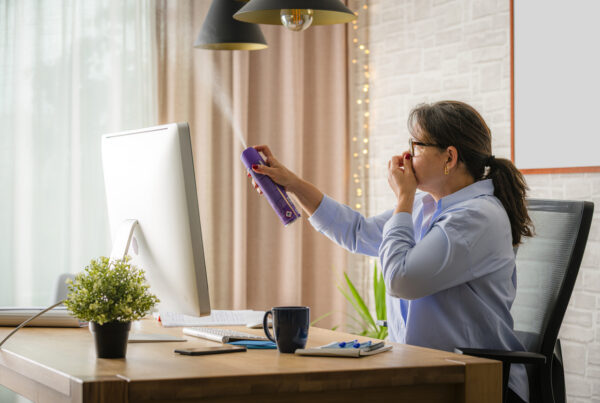
Scent, memory, and emotion are closely related. That’s because they’re all managed by the same part of the brain. Successful branding builds on that connection.
You want them to recognize you for positive reasons, not because your store literally stinks! Off-putting odors leave a mark in customers’ minds. Employees, too. Those memories may manifest in many ways:
- Absence/erosion of customer trust
- Negative/embarrassing online reviews
- Poor employee satisfaction and retention
- Low dwell time
- Inconsistent reputation
The key to positive branding is consistency: make a promise to your customers and your employees, and keep it. That way, they’ll remember your brand as one that protects their experience, prioritizes their comfort, and earns their loyalty.
Discover How Scent Marketing and Odor Control Elevate Employee Well-Being.
FAQs about Scent and Time of Day
Why does my office smell worse in the afternoon?
Offices often smell worse in the afternoon due to rising temperatures, increased humidity, higher occupancy levels, and HVAC cycling changes. As the day progresses, heat and moisture activate odor molecules and intensify existing sources like restrooms, trash bins, carpets, and floor drains. Increased foot traffic and restroom usage can also amplify lingering odors that were less noticeable in the cooler morning hours.
Can HVAC systems cause odor fluctuations?
Yes, HVAC systems can significantly impact odor fluctuations throughout the day. As systems cycle on and off, air pressure shifts can pull odors from restrooms, breakrooms, floor drains, or adjacent tenant spaces and redistribute them through ductwork. In multi-tenant buildings, shared ventilation systems can even transfer odors between suites. Changes in airflow patterns often explain why a building smells different at specific times of day.
Does humidity make odors stronger?
No. Scent marketing complements proper odor management by enhancing perception and experience rather than masking problems.
Humidity can make odors noticeably stronger. Moisture in the air binds with odor molecules, increasing their intensity and making them more detectable. Higher humidity levels also promote bacterial growth on surfaces like carpets, drains, and trash receptacles, which can worsen persistent building odors. This is why many commercial spaces experience stronger odor issues during summer months or on particularly humid days.
Why does the smell disappear overnight?
Odors often seem to disappear overnight because environmental conditions change. Cooler temperatures, lower humidity levels, and reduced occupancy decrease the volatility of odor molecules. Without heat and activity to activate them, smells become less noticeable. However, the source of the odor usually remains and will reactivate the next day when temperature, humidity, and foot traffic increase again.
Conclusion: Consistency Is the Goal
 Experiencing inconsistent scent quality in your building? Heat, humidity, and HVAC activity play a role. So do the number of customers…and the amount of bacteria.
In a case like this, masking the bad odors won’t fix the problem. For that, you need to focus on true odor control that attacks bacteria at its source(s). When you do, your entire business will benefit from a setting that smells consistently clean, from open to close.
Get a handle on inconsistent odors with pro-quality products and services from Aire-Master.