
Introduction: Why Smell Is Neurologically Different
Think of our five senses and how important they are to our experience. How would you rank them? Many people put sight first, or even sound. Ask a neuroscientist, though, and they’ll tell you smell is most important. That’s because, scientifically speaking, smell has a special advantage.
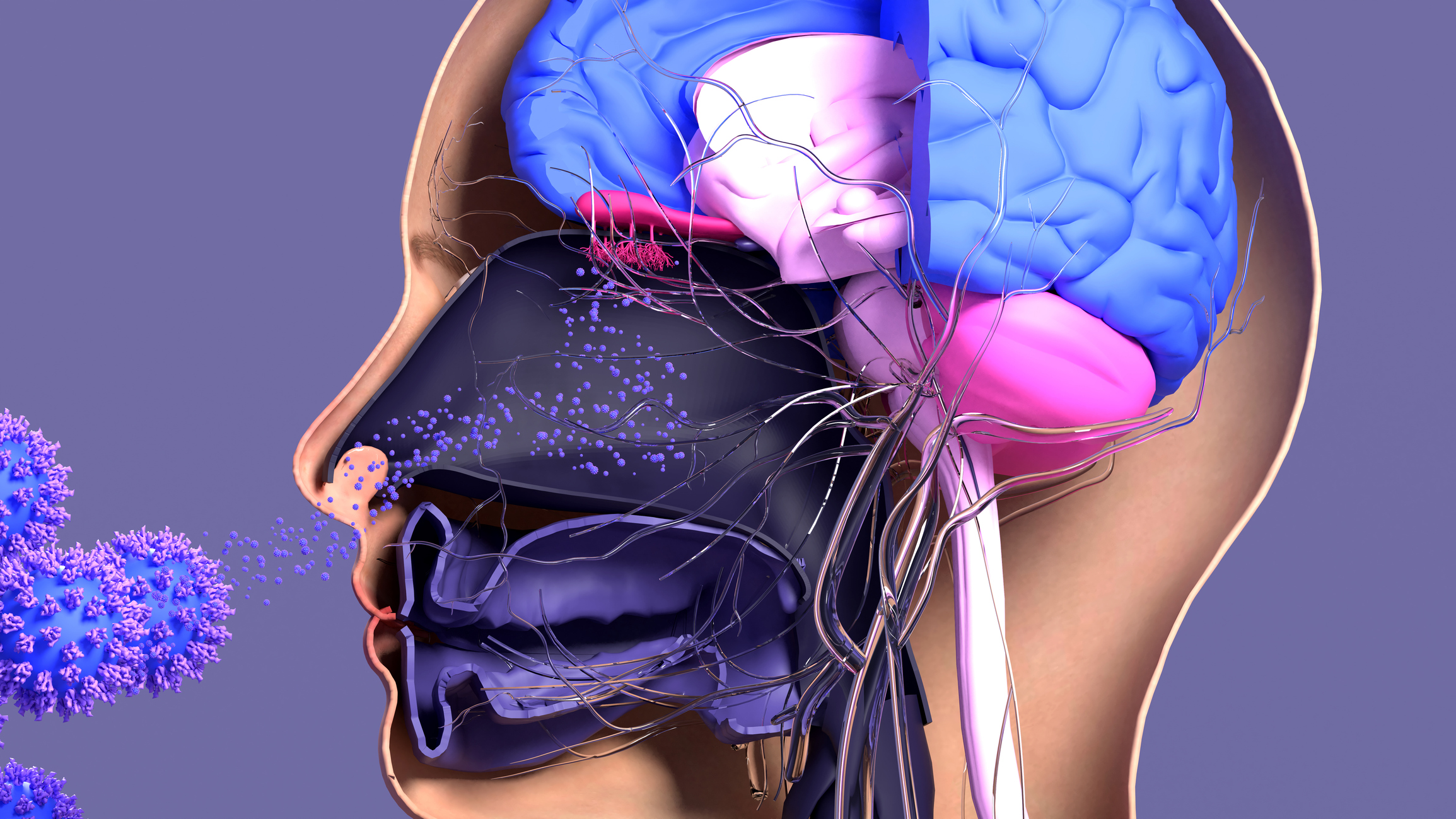
All five senses deliver data to the human brain, but only smell has direct access to the limbic system. It’s our brain’s control center for three key elements of our existence: memory, mood, and emotion.
The limbic system has an outsized influence on the way we process the information our noses deliver. If we smell smoke, for instance, it’s the limbic system that identifies that aroma and flashes an immediate “DANGER” warning.
This direct connection between scent and the brain means that smells are processed at lightning speed. Whereas other senses allow us a chance to logically process what they tell us (and respond), our sense of smell provokes quick reactions. The way our brains process scent has a significant effect on how we perceive the world and make decisions.
The Olfactory System: A Direct Line to the Brain
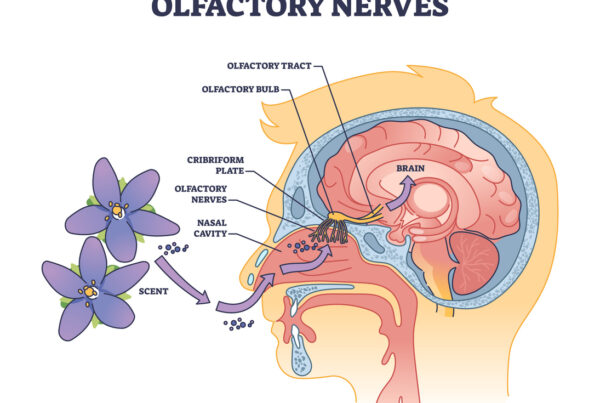
Scents are particle-based, which means our brains have to sift through the billions of molecules we breathe in. Turning those smells into meaningful information happens in the olfactory epithelium. This area of the brain features several cell types; the most important is called the olfactory receptor neuron.
As defined by the National Institutes of Health, this “bipolar cell…gives rise to a small-diameter, unmyelinated axon at its basal surface that transmits olfactory information centrally.” [SOURCE]
When scent molecules enter the olfactory system, olfactory receptor neurons go to work, finding matches and patterns and then passing that critical data straight to the olfactory bulb.
It’s important to note that this trove of sensory information does not enter the thalamus, as the data collected by our senses of sight, hearing, taste, and touch does. As a result, no rational filtering occurs, explaining why smells can be so powerful emotionally and have such strong memory connections.
Read more about How Scent Works in our recent blog.
The Olfactory Bulb and the Limbic System
The olfactory bulb functions like a processor wired directly to the limbic system. As it collects information from the molecules we inhale, it sends them to the hippocampus, a seahorse-shaped part of our brains that stores memories. Along with the amygdala, the hippocampus is one of the two most important structures in the limbic system.
Focusing on both the psychology and neurobiology of our sense of smell, Professor Jonas Olafson of Stockholm University has been researching how smell impacts perception, memory, and emotion. He’s found evidence of a strong link between our sense of smell and the hippocampus, helping confirm the often-mentioned connection between smells and personal memories.
“The results,” he says, “show that the hippocampus resonates with the olfactory brain more than the other senses. This suggests there is a kind of ‘highway’ between these regions that is unique to our sense of smell, and that might partly explain why smells trigger such vivid memories.” [SOURCE]
Vivid, yes. More emotionally impactful, too. Research into the subject consistently indicates that our brains don’t just recognize scents…they relive the emotions associated with that smell, as well.
Scent, Memory Encoding, and Long-Term Association
The more intense an emotional experience is, the more deeply held the memory of it will be. They’re directly linked. If a certain smell is associated with that emotion, the connection can be even deeper. As time passes, the memory-associated aroma grows in influence, sometimes becoming as powerful and triggering as the experience itself.
The smell of a place can have surprisingly powerful effects, too, even if it’s been years since we encountered it. Just like sights and sounds and tastes, scents make up part of our physical environment. And when we recall them, we also remember the sensory architecture surrounding them. In other words, scents help anchor us to our world, both in the present time and in memory.
A recent meta-analysis on olfactory spatial memory suggests that “odors can be used as landmarks in the formation of neuro-cognitive maps in both sensory and cognitive brain areas, providing a foundation for spatial memory and navigation abilities.” [SOURCE]
Once you understand these processes, it’s easy to see how powerful scent marketing can be. For retail stores, destination getaways, and even healthcare facilities, encouraging certain behaviors by releasing specific scents into the air is innovative science and good business.
Explore the Future of Sensory Branding in our recent blog.
What This Science Means for Businesses
Knowing the science behind how humans interact with scent is reassuring, especially for businesses intent on enhancing their olfactory branding efforts. The fact-based approach makes it easier to connect the dots and see how ROI can be achieved.
How Scent Influences Customer Behavior
In stores, hotels, and offices, fragrances work in the background, quietly and subtly influencing customer behavior. For a business owner or store manager looking to boost brand identity and encourage customer engagement, they’re ideal employees who never take a day off or complain about long hours. Studies have shown that smells are capable of:
- Lowering stress and calming anxiety
- Uplifting mood (for both customers AND employees)
- Lengthening shopping (dwell) time
- Boosting customer engagement
- Enhancing the overall perception of the brand
Why “Clean Smell” Builds Immediate Trust
Scent marketing helps boost brand perception and build trust by delivering a clean, consistent scent. It works because when we smell a clean scent, it tells us that the area is safe and the people working there are capable. Without a threat to get keyed up for, customers are able to settle in, relax, and enjoy the experience.
Successful businesses benefit from customer trust. Certain types of institutions benefit more than others. They include:
- Medical facilities
- Financial offices
- Professional services
- Retail stores
Learn more about The Psychology of a Clean Smell and how it builds trust.
Scent as a Non-Verbal Brand Signal
For centuries, purveyors of goods and services have used logos, slogans, and colors to lock in brand recall. Scent can serve the same function, anchoring customers to the brand in a new (yet familiar) way.
Scent works best this way, as a subtle supplement. It doesn’t seek attention, but it gains attention in a subtle, seductive way. Done right, scent branding is one part of a multilevel marketing strategy, subtly yet reliably delivering results for your business.
Enacting Neuroscience in Real Environments
To set your business up for scent marketing success, you must take the process seriously—similar to a science experiment. You need to establish controls, be consistent, and prioritize safety. Without precision, it is harder to measure and achieve results.
If you feel uncertain about implementing neuroscience in a real setting without guidance, consider leveraging advice from an expert. Professional scent branding services from Aire-Master turn theory into practice, helping your business:
- Understand what scent can (and can’t) do
- Help select (or create) scents that best fit your brand
- Fine-tune intensity to achieve consistency
- Ensure consistency across multiple locations
Find out more about professional scent marketing with Aire-Master.
FAQs about Neuroscience and Scent
How does the brain process scent differently than sight or sound?
Scent bypasses the thalamus and connects directly to emotional and memory centers, making it faster and more emotionally influential.
Why does smell trigger memories so strongly?
Because scent is processed alongside the hippocampus and amygdala, linking emotion and memory tightly together.
Is scent marketing supported by neuroscience?
Yes. Numerous studies confirm scent’s influence on mood, perception, and behavior.
Can scent really influence customer behavior?
Scent affects emotional state and comfort, which directly impacts dwell time and decision-making.
What types of businesses benefit most from scent marketing?
Retail, healthcare, hospitality, offices, and any environment where trust and comfort matter.
Turning Brain Science into Business Advantage
 Scent is a sense all its own. It has special access to our brain’s control center for mood, memory, and emotion…and the sensory data it delivers is processed before logical filtering even enters the picture. Businesses can leverage that “gut feeling” customers get in their store, office, or facility by leaning into the benefits of scent marketing.
Get a quote today to see how Aire-Master can help your business turn neuroscience into a better experience for your customers…and better results for you.